As fuel prices have climbed and emissions standards have become stricter, the prevalence of the Auxiliary Power Unit for over-the-road trucking has increased. Pull through any local truck stop and you will see the defining characteristic of the condenser mounted on the back of a truck cab, indicating that the truck is equipped with an Auxiliary Power Unit or APU.
What is a Truck APU (Auxiliary Power Unit)?
Think of an APU as a generator for the sleeper cab of a semi-truck. This generator can produce or store power for use while the main truck engine is off. These units are either diesel powered or battery powered and provide a variety of functions to increase the driver’s comfort while they are parked. Drivers use APUs so that they don’t have to idle their truck throughout the night to maintain a comfortable environment in the cab.
What does an APU do on a truck?
The most basic function of an APU is to cool the sleeper cab while a driver rests.
Many APUs also include other useful functions such as in-cab heat, engine pre-heat, and 120V power. As the market has expanded, functionality of these APU systems has broadened.
Types of Truck APUs
In general, there are two basic types of APUs.
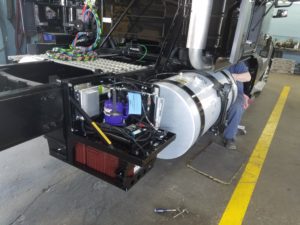
A diesel APU will have a small diesel engine mounted on the frame rail of the truck, typically behind the fuel tank and in front of the first axle. This engine will run off the truck’s fuel supply and power a compressor, alternator, or generator. An electric APU will use a battery bank that may be mounted to the frame rail or integrated into the truck. Each system has strengths and weaknesses and should be matched to the truck’s typical operation.
Diesel Truck APUs
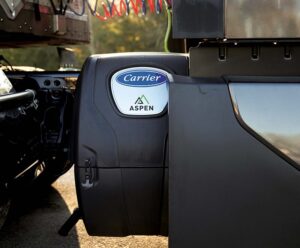
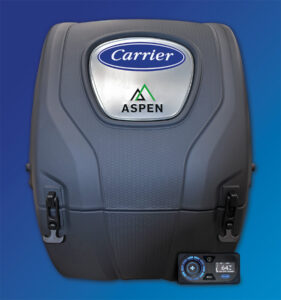
Diesel APUs are frame mounted and run off the fuel supply from the truck. When the driver parks and shuts off their truck, they will start this APU by pushing a button on the control panel inside the cab. The APU will then start up and begin cooling the trucks cabs. The most common APU systems are the Carrier Aspen APU and the ThermoKing TriPac APU. Most diesel systems are capable of cooling the truck cab, preheating the truck’s engine, and charging the truck’s 12V battery system, however there are some other differences in the operation.
Electric APUs for Trucks
Electric APUs take a different approach than diesel systems. Instead of a small engine mounted to the frame rail, they rely on a high-capacity battery bank that stores and delivers power for cab comfort and auxiliary loads when the main truck engine is off. These systems are typically mounted to the frame rail or integrated into existing truck battery architecture, depending on the configuration and application.
In most setups, the battery bank is charged while the truck is in operation through the alternator, and in some configurations through shore power when parked. That stored energy is then used to support cab HVAC functions, run accessories, and maintain driver comfort without idling the main engine.
Diesel vs Electric APUs
Compared to diesel APUs, electric systems eliminate onboard combustion. That means no secondary engine maintenance, no fuel draw from the truck, and significantly reduced noise while parked. For fleets operating in urban environments or regions with strict anti-idling regulations, this can be a meaningful operational advantage.
Electric APUs are often best suited for predictable duty cycles where trucks return to base or have reliable charging intervals. They are commonly considered by fleets focused on reducing emissions, improving driver comfort, and simplifying maintenance requirements.
While diesel APUs remain strong for extended off-grid runtime and heavy auxiliary loads, electric systems represent a growing option for fleets looking to reduce mechanical complexity and idle-related costs while maintaining essential cab power when the truck is stationary.
Carrier Aspen APU: Diesel APU of Choice
The Carrier Diesel APU engine powers a 5.3kW generator that supplies 120V power to the cab. The compressor is a fully sealed (hermetic) compressor powered by the 120V system, operating similarly to a household refrigeration system. Since the system is already supplying 120V power, a plug is mounted inside the bunk, giving the driver access to power without the need for an inverter. Also standard, is electric heat, which provides 8,200 BTU/hr. of instant heat to the cab. Because everything is designed to operate on 120V power, an optional shore power kit can be installed so that all the conveniences are available by plugging the unit into 120v shore power, without the need to run the diesel engine.
Cold Weather Watch
On our standard APU installation, the APU engine coolant system is tied into the truck engine, therefore running warm coolant throughout the tractor’s engine and pre-heating the truck engine in cold temperatures. The controller can be programmed to monitor the ambient temperature and run the APU for a predetermined amount of time when the temperature falls under the set temperature. Also, the APU can be programmed to start at a certain time, similar to a coffee pot, so that the cab is at a comfortable temperature for the driver at the start of a day.
Battery Monitor
The Carrier APU also includes the battery monitor as a standard feature. The battery monitor will gauge the truck’s battery and start up automatically if the voltage falls under a pre-determined level. This is beneficial to drivers who may park their truck unattended for an amount of time. Also, if the truck alternator malfunctions while driving, the APU will sense the voltage drop and turn on, allowing the driver to drive to the truck repair shop.
Many of these features may be offered by other manufacturers, however, be sure to confirm prior to purchase.
Thinking Beyond the Basics of an APU?
An APU is just one part of a bigger picture—fuel savings, compliance, uptime, and long-term fleet efficiency. If you’re researching APUs, these resources can help you make smarter decisions about how your truck (or fleet) operates day to day.
- Top Reasons Your APU Keeps Shutting Off
- FMSA and Anti-Idle Regulations
- Advantages of Fleet Maintenance and Management
About Electric APUs & Installation
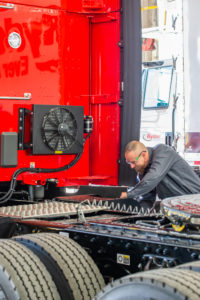
a condenser mounted on the rear of the truck cab
Electric APUs come in many shapes and sizes. Some electric APUs will have a frame mounted battery bank that will appear similar to the diesel APU frame mount. Other APUs may be integrated into the truck’s 12V battery system. The easiest way to identify if a truck has an APU is to look for the condenser, which is a small rectangular box mounted outside the rear of the truck cab. The condenser is like a mini radiator that helps remove the heat from the inside of the cab.
Many trucks are coming installed with electric APUs from the factory. These units will tie into the truck’s 12V system to provide in-cab cooling. Most systems will also include a low battery cut-off or auto start which starts the trucks engine when the battery falls under a set threshold. While this is an inexpensive APU system, many drivers complain of a shorter run time and of trouble staying asleep while the truck engine may cycle on and off.
The Carrier APU has its own battery bank of 4 AGM batteries with a fully sealed (hermetic) compressor. The compressor is a 12V compressor, eliminating the power losses when converting power from AC to DC. Because the battery is separate from the trucks battery system, the APU does not cycle the truck’s batteries, causing additional wear on the truck’s batteries. Instead, the APU batteries take the load of the APU and are charged by the truck when the truck is running. Because of the additional load on the trucks charging system, Carrier recommends that the truck be equipped with a 240 amp or larger alternator.
New for 2023, Carrier is offering a Lithium-ION battery option. These heavy-duty systems are designed to handle cyclical charging and discharging without a loss in performance. While these systems come at an increased price, they are designed to last up to 10 years of normal use.
Electric APU Limitations
While electric APUs offer nearly emission-free and maintenance-free operation, they are limited in capabilities. Electric APUs need to be charged between each use. This means that the truck engine must be run for 6 or more hours to charge the system. In-cab heat is usually handled by a fuel-fired bunk heater. Engine pre-heat is usually handled through a fuel-fired coolant heater. These options will add to the cost of an electric APU.
Which Truck APU is right for me?
 What APU best suits you depends on your needs, the preexisting equipment on your tractor, and what your budget is. Tractors are unique in frame length, fairings, optional accessories., etc.
At Crosspoint Power and Refrigeration, our APU experts are here to deliver the right solution for your unique operation and unique truck. We will start with a free assessment of your truck to determine the correct placement. Just because you may not see clear frame rail space doesn’t mean an APU will not fit. We have mounted APUs in toolboxes, under fairings, and even under steps. Crosspoint Power and Refrigeration takes pride in finding creative solutions for our customers. We will also consider vent placement, control panel location, and 120v receptacle position. From there, we will work with your schedule to ensure minimal downtime for your operation. Our professional installation crew will have most installations complete in two days or less.
If you have any questions, don’t hesitate to contact us!
FAQs About Truck APUs
What is an APU on a truck?
An Auxiliary Power Unit (APU) is a secondary power system installed on a semi-truck that allows drivers to run cab functions—like air conditioning, heat, and electrical power—without idling the main engine. It improves comfort during rest periods while reducing fuel consumption and engine wear.
How does a truck APU work?
A truck APU works by generating or storing power when the main engine is off. Diesel APUs use a small onboard engine to produce power for HVAC and electrical systems, while electric APUs use stored battery power charged while the truck is running or plugged into shore power. Both systems are designed to maintain sleeper cab comfort without idling.
What is the difference between a diesel and electric APU?
Diesel APUs use a small fuel-powered engine mounted on the truck frame to generate power and run HVAC systems continuously for long durations. Electric APUs rely on high-capacity battery banks that store energy and deliver it when the truck is parked.
Diesel systems like the Carrier Aspen APU or Thermo King TriPac APU typically support longer off-grid runtime, while electric systems reduce emissions, noise, and maintenance needs.
Is an APU worth it for truck drivers and fleets?
Yes—APUs are widely considered worth the investment for both owner-operators and fleets. They reduce the need for engine idling, which lowers fuel costs, decreases engine wear, and helps comply with anti-idling regulations. They also improve driver comfort by providing consistent cab temperature control and electrical power during rest periods.